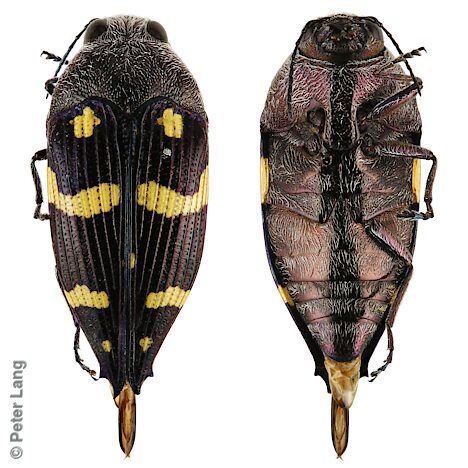
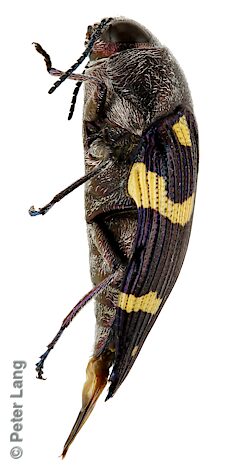
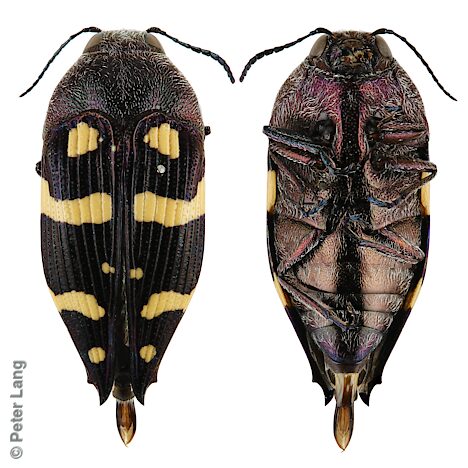
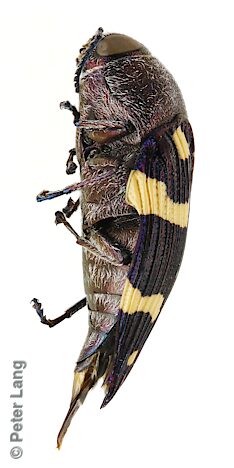
Actual
size¹:
size¹:
9.0 mm
×
3.8 mm
×
3.8 mm
| male | ||||||
|---|---|---|---|---|---|---|
| L1 | 9.0 | 8.8 – 9.15 | n = 2 | |||
| L2 | 8.9 | 8.75 – 9 | n = 2 | |||
| W | 3.8 | 3.8 – 3.85 | n = 2 | |||
| Legend | L1 | length from clypeus/frons to elytral apex (mean, range, sample size) |
| L2 | length from anterior of edge of eyes to elytral apex | |
| W | maximum width with elytra fully closed |
Barker 1989 noted that 'A. badeni differs from its congeners in the bulbous appearance of the pronotum and the more abruptly tapering apices of the elytra. It is a short broad species.'
| Legend | P.J.Lang collection vouchered records | |
| other private collection or museum specimens, or sightings |
| beetles | sites | SA regions¹ | family | position on host plant | ||
| Callitris gracilis | 1 | 1 | NL | C |
| Legend | beetles | count of beetles collected from, or sighted on, host plant taxon |
| sites | count of major sites (unique 10 km grid cells +/- some distinct approximate localities) | |
| Plant names in green are hyperlinked to a matching host species page with plant photos. | ||
| Code | beetles | % | host plant taxa | |
| C | Cupressaceae | 1 | 100% | 1 |
| position | beetles | sites | |
| on plant (unspecified) | 1 | 1 |
| colour | beetles | sites | SA regions¹ | |
| light pink | 1 | 1 | SE | |
| light violet | 1 | 1 | SE |
There is an early collection of this species in the SA Museum made by J.G.O. Tepper at Nuriootpa (in the Barossa Valley) recorded on the label as 'from Callitris'. This is assumed to be Callitris gracilis which is the only species of Native Pine occuring in that area.
In north-western Victoria adults have been caught on the foliage of Melaleuca lanceolata (Dryland Tea-tree) that was not in flower (A.M.Sundholm, 2013, pers. comm).
| ¹ Legend | regions | SA State Herbarium regions (map) EA: Eastern, EP: Eyre Peninsula, FR: Flinders Ranges, GT: Gairdner-Torrens, KI: Kangaroo Island, LE: Lake Eyre, MU: Murray, NL: Northern Lofty, NU: Nullarbor, NW: North-Western, SE: South-Eastern, SL: Southern Lofty, YP: Yorke Peninsula |
| size | The ellipse is the correct size when printed, indicative on a desktop screen, and likely to be wrong on a mobile device. |