| male | female | |||||
|---|---|---|---|---|---|---|
| L1 | 6.9 | 6.45 – 7.3 | n = 5 | 6.8 | 6.1 – 7.65 | n = 5 |
| L2 | 6.7 | 6.4 – 7.1 | n = 4 | 6.7 | 6 – 7.55 | n = 5 |
| W | 2.7 | 2.5 – 2.9 | n = 5 | 2.7 | 2.4 – 3 | n = 5 |
| Legend | L1 | length from clypeus/frons to elytral apex (mean, range, sample size) |
| L2 | length from anterior of edge of eyes to elytral apex | |
| W | maximum width with elytra fully closed |
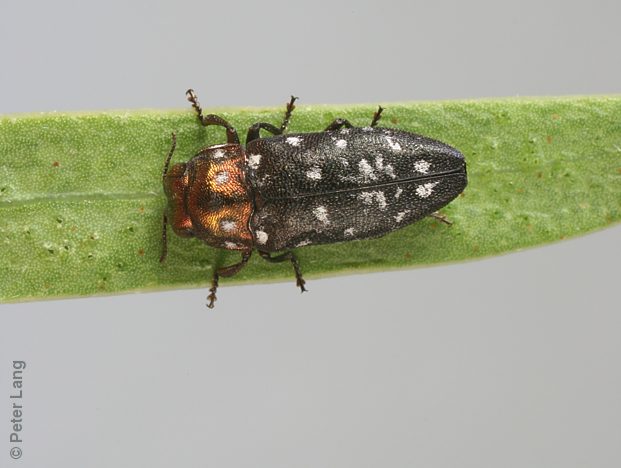
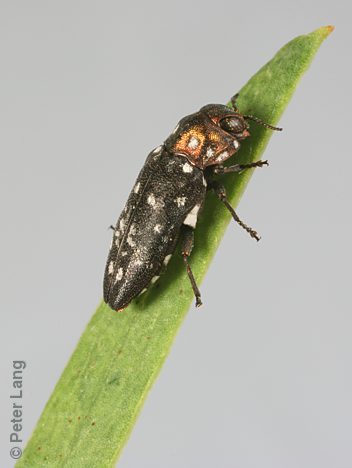
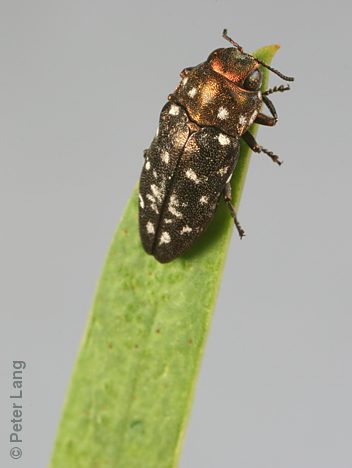
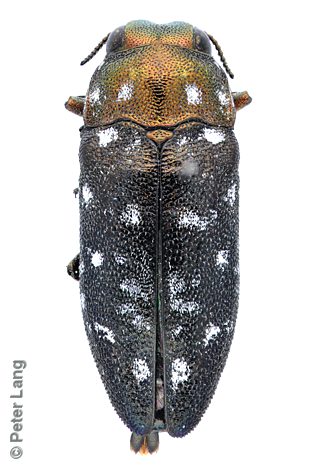
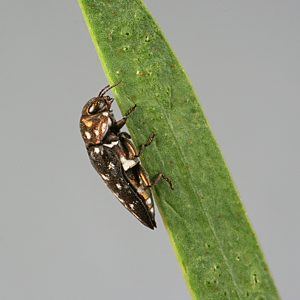
Pronotum with strongly impressed dimple-shaped foveae one on either side of the medial boss in the basal half; conspicuous, dense, white, often flocculent scale-hair patches in pronotal foveae and on the blackish elytra where the eight major patches form a circular pattern. Males with pronotum, scutellum and most of ventral side below prosternum green-gold to gold or copper. Females broader, with a blackish pronotum (dark grey +/- weak purple-bronze reflections) and superficially resembling D. notulata; sometimes with weak blue reflections above, and ventral side below pronotum softly metallic (violet-) blue. Body shape more elongate and not as thick and broad in the anterior as in both sexes of D. cupreola.
This species has strong sexual dichromatism, with males and females being differently coloured in their upper parts and undersides. It appears that Hope 1846a mistook them for two different species. He described Ethon cupreicolle with a male holotype from 'Moriatta' (referring to Morialta on the Adelaide hills escarpment), and followed it in the same paper with Ethon aenicolle based on a female holotype from Adelaide. Saunders 1868a transferred them to Cisseis (now Diphucrania) and relegated aenicolle to a variety of cupreicollis. Eventually Carter 1923a recognised them as different sexes of the same taxon and made aenicolle a synonym of cupreicollis. His key entry for Cisseis cupreicollis states: ' Pronotum copper (male) or bluish (female) ..' A Museums Victoria collection of J.G.O. Tepper from Nuriootpa in the Barossa Valley of SA (most likely made in the late 19th century) comprises a coppery male and bluish female mounted side by side on the same card.
Although having a wide distribution and extending into arid areas, D. cupreicollis was until recently collected only very rarely in South Australia. The occurrences in MU region are on the eastern edge of the Mt Lofty Ranges.
On 11 December 2025 Jason van Weenen found large numbers of D. cupreicollis, both males and females, in in the hills west of Sanderston.
| Legend | P.J.Lang collection vouchered records | |
| other private collection or museum specimens, or sightings |
|
|
|
|
|
|
|
|
|
|
|
|
|
||||||||||||||||||||||||||||||||||||||||||||||||
|
|
|
|
|
|
|
|
|
|
|
|
|
||||||||||||||||||||||||||||||||||||||||||||||||
| Jul | Aug | Sep | Oct | Nov | Dec | Jan | Feb | Mar | Apr | May | Jun |
| Legend | ||
9 | number of active beetles, actually recorded in that quarter-month | |
| actual count > 1 (median) | ||
| actual count <= 1 (median) | ||
| beetles | sites | SA regions¹ | family | position on host plant | |||
| Acacia pycnantha | 97 | 1 | MU | F | |||
| Allocasuarina verticillata | 6 | 1 | MU | C | |||
| Acacia argyrophylla | 3 | 1 | MU | F | |||
| Eremophila longifolia | 3 | 1 | EP | S | |||
| Acacia ligulata | 1 | 1 | MU | F |
| Legend | beetles | count of beetles collected from, or sighted on, host plant taxon |
| sites | count of major sites (unique 10 km grid cells +/- some distinct approximate localities) | |
| Plant names in green are hyperlinked to a matching host species page with plant photos. | ||
| Code | beetles | % | host plant taxa | |
| F | Fabaceae | 101 | 92% | 3 |
| C | Casuarinaceae | 6 | 5% | 1 |
| S | Scrophulariaceae | 3 | 3% | 1 |
| position | beetles | sites | |
| on flowering plant | 1 | 1 | |
| on foliage or non-flowering plant | 109 | 2 |
Where the species was recorded recently in large numbers, it was found on foliage of three species of small trees or shrubs which were sparsely present in predominantly grassland vegetation. So far there is no clear indication from adult host records of what the larval host might be.
| ¹ Legend | regions | SA State Herbarium regions (map) EA: Eastern, EP: Eyre Peninsula, FR: Flinders Ranges, GT: Gairdner-Torrens, KI: Kangaroo Island, LE: Lake Eyre, MU: Murray, NL: Northern Lofty, NU: Nullarbor, NW: North-Western, SE: South-Eastern, SL: Southern Lofty, YP: Yorke Peninsula |
| size | The ellipse is the correct size when printed, indicative on a desktop screen, and likely to be wrong on a mobile device. |