


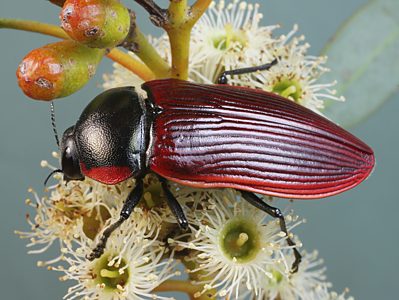
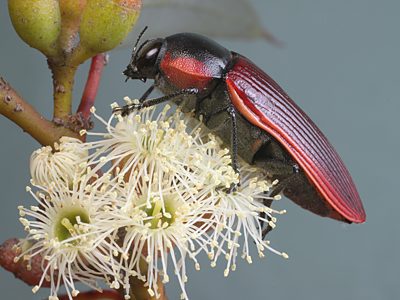


Actual
size¹:
size¹:
26.3 mm
×
11.1 mm
×
11.1 mm
| male | female | |||||
|---|---|---|---|---|---|---|
| L1 | 25.8 | 22.9 – 29.3 | n = 3 | 27.1 | 26.8 – 27.4 | n = 2 |
| L2 | 25.6 | 22.9 – 28.45 | n = 3 | |||
| W | 10.8 | 9.95 – 11.6 | n = 3 | 11.4 | 11.4 – 11.5 | n = 2 |
| Legend | L1 | length from clypeus/frons to elytral apex (mean, range, sample size) |
| L2 | length from anterior of edge of eyes to elytral apex | |
| W | maximum width with elytra fully closed |
Superficially similar to T. flavomarginata (q.v.) but thicker in form, with wider yellow margins on sides of pronotum and lacking the short yellow strip below the scutellum. Also, pronotum is shinier with finer puncturation and lacks the coarser sculpturing of T. flavomarginata.
The colouration of this species is variable. The forms with yellow margins, which seem to predominate in SA, were previously treated on these pages as T. cf. marginalis.
The individual with red margins shown here is somewhat atypical in its broader shape. In the original description by Carter 1929b based on material from WA, he states: 'the pronotum very nitid and glabrous, with an orange margin not extending to base; elytra dark brown, becoming reddish-brown towards apex, with an orange margin throughout'.
Individuals collected on upper Eyre Peninsula vary greatly in the extent of the pigmented vs pale/testaceous colouration of abdominal ventrites, even within a single site.
An unusual specimen (PL6345) collected in Barmera on the River Murray appears closest to this species and is provisionally included here. As well as its pale colouration, it is notable for having black tips on the elytral apices, a feature that is also seen on one specimen of T. marginalis from Round Hill in NSW.
| Legend | P.J.Lang collection vouchered records | |
| other private collection or museum specimens, or sightings |
|
|
|
|
|
|
|
|
|
|
|
|
|
||||||||||||||||||||||||||||||||||||||||||||||||
|
|
|
|
|
|
|
|
|
|
|
|
|
||||||||||||||||||||||||||||||||||||||||||||||||
| Jul | Aug | Sep | Oct | Nov | Dec | Jan | Feb | Mar | Apr | May | Jun |
| Legend | ||
9 | number of active beetles, actually recorded in that quarter-month | |
| actual count > 2 (median) | ||
| actual count <= 2 (median) | ||
| beetles | sites | SA regions¹ | family | position on host plant | |||
| Eucalyptus leptophylla | 5 | 1 | EP | M | |||
| Eucalyptus dumosa | 2 | 2 | EP | M | |||
| Eucalyptus brachycalyx | 1 | 1 | EP | M | |||
| Melaleuca lanceolata | 1 | 1 | EP | M |
| Legend | beetles | count of beetles collected from, or sighted on, host plant taxon |
| sites | count of major sites (unique 10 km grid cells +/- some distinct approximate localities) | |
| Plant names in green are hyperlinked to a matching host species page with plant photos. | ||
| Code | beetles | % | host plant taxa | |
| M | Myrtaceae | 9 | 100% | 4 |
| position | beetles | sites | |
| on flower(s) | 7 | 2 | |
| on flowering plant | 1 | 1 | |
| on plant (unspecified) | 1 | 1 |
| ¹ Legend | regions | SA State Herbarium regions (map) EA: Eastern, EP: Eyre Peninsula, FR: Flinders Ranges, GT: Gairdner-Torrens, KI: Kangaroo Island, LE: Lake Eyre, MU: Murray, NL: Northern Lofty, NU: Nullarbor, NW: North-Western, SE: South-Eastern, SL: Southern Lofty, YP: Yorke Peninsula |
| size | The ellipse is the correct size when printed, indicative on a desktop screen, and likely to be wrong on a mobile device. |