


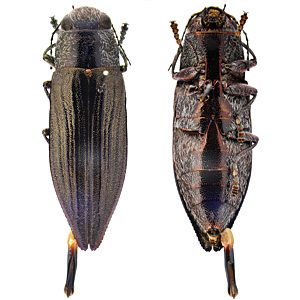
Actual
size¹:
size¹:
14.6 mm
×
4.7 mm
×
4.7 mm
| male | female | |||||
|---|---|---|---|---|---|---|
| L1 | 14.2 | 13.4 – 14.9 | n = 2 | 15.6 | n = 1 | |
| W | 4.5 | 4.3 – 4.7 | n = 2 | 5.2 | n = 1 | |
| Legend | L1 | length from clypeus/frons to elytral apex (mean, range, sample size) |
| L2 | length from anterior of edge of eyes to elytral apex | |
| W | maximum width with elytra fully closed |
Resembles some specimens of Melobasis soror basicostata from WA, but has larger overall size with aedeagus longer and distinct in shape. Close to M. nervosa but differing by its more convex shape (in lateral view), dark grey rather than bronze coloration, aedeagus morphology, and the teeth at extreme elytral apices being blunter, shallower and sparser.
This appears to be an undescribed species (or subspecies) allied to M. nervosa and associated with the Northern Mt Lofty and Flinders Ranges.
| Legend | P.J.Lang collection vouchered records | |
| other private collection or museum specimens, or sightings |
|
|
|
|
|
|
|
|
|
|
|
|
|
||||||||||||||||||||||||||||||||||||||||||||||||
|
|
|
|
|
|
|
|
|
|
|
|
|
||||||||||||||||||||||||||||||||||||||||||||||||
| Jul | Aug | Sep | Oct | Nov | Dec | Jan | Feb | Mar | Apr | May | Jun |
| Legend | ||
9 | number of active beetles, actually recorded in that quarter-month | |
| actual count > 1 (median) | ||
| actual count <= 1 (median) | ||
| beetles | sites | SA regions¹ | family | position on host plant | ||
| Acacia calamifolia | 2 | 2 | FR | F | ||
| Acacia wattsiana | 2 | 1 | NL | F |
| Legend | beetles | count of beetles collected from, or sighted on, host plant taxon |
| sites | count of major sites (unique 10 km grid cells +/- some distinct approximate localities) | |
| Plant names in green are hyperlinked to a matching host species page with plant photos. | ||
| Code | beetles | % | host plant taxa | |
| F | Fabaceae | 4 | 100% | 2 |
| position | beetles | sites | |
| on flowering plant | 2 | 1 | |
| on foliage or non-flowering plant | 2 | 2 |
| ¹ Legend | regions | SA State Herbarium regions (map) EA: Eastern, EP: Eyre Peninsula, FR: Flinders Ranges, GT: Gairdner-Torrens, KI: Kangaroo Island, LE: Lake Eyre, MU: Murray, NL: Northern Lofty, NU: Nullarbor, NW: North-Western, SE: South-Eastern, SL: Southern Lofty, YP: Yorke Peninsula |
| size | The ellipse is the correct size when printed, indicative on a desktop screen, and likely to be wrong on a mobile device. |