

Actual
size¹:
size¹:
12.2 mm
×
4.5 mm
×
4.5 mm
| male | female | |||||
|---|---|---|---|---|---|---|
| L1 | 12.2 | 9.7 – 14.3 | n = 40 | 11.0 | n = 1 | |
| L2 | 12.1 | 9.5 – 14.15 | n = 39 | 10.8 | n = 1 | |
| W | 4.5 | 3.7 – 5.25 | n = 40 | 4.1 | n = 1 | |
| Legend | L1 | length from clypeus/frons to elytral apex (mean, range, sample size) |
| L2 | length from anterior of edge of eyes to elytral apex | |
| W | maximum width with elytra fully closed |
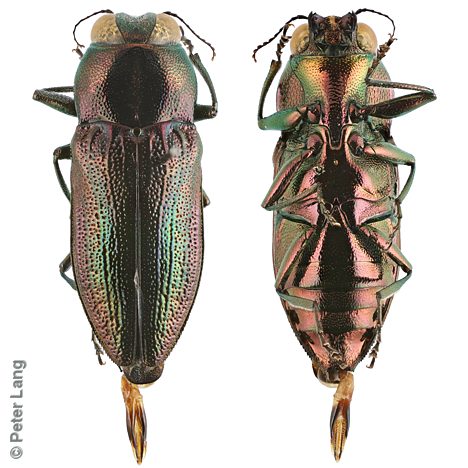
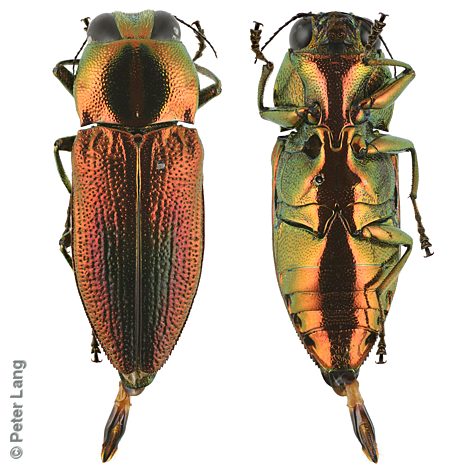
In his revision of the genus (known then as Curis) Carter 1928 separated Selagis corusca in his key by the elytra being unicolourous and coppery. He referred to a mutilated example in the SA Museum from Adelaide. An early Adelaide collection by Tepper has light coppery elytra consistent with his account.
The original description by Waterhouse 1882 however, makes no mention of copper colouration and only refers to colour on the pronotum 'tinted with golden green on the disk' and with short deep blue elongated spots on either side of the midline. Waterhouse's final comment that it formed a link between S. caloptera and S. viridicyanea suggests that his material may have had elytra with substantial green colouration. He merely designates the source of material as Australia.
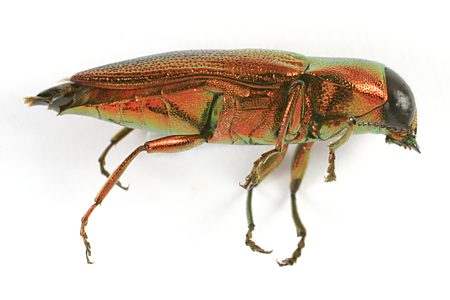
Many Eyre Peninsula specimens matching S. corusca in size and body shape size are brightly and predominantly copper-coloured throughout, but others grade towards blackish-purple tones particularly on the elytra, and a few exhibit greenish tones. Carter 1928, p.275 commented on the bewildering colour variation in some species of the genus. Examination of images of type specimens also indicates much colour variation in this species.
| Legend | P.J.Lang collection vouchered records | |
| other private collection or museum specimens, or sightings |
|
|
|
|
|
|
|
|
|
|
|
|
|
||||||||||||||||||||||||||||||||||||||||||||||||
|
|
|
|
|
|
|
|
|
|
|
|
|
||||||||||||||||||||||||||||||||||||||||||||||||
| Jul | Aug | Sep | Oct | Nov | Dec | Jan | Feb | Mar | Apr | May | Jun |
| Legend | ||
2 | estimate of active beetles, inferred* from adjoining date ranges | |
| inferred* active beetles only (mostly from colour lure trap results) | ||
| *Inferred when a site has counts of active beetles for each of two consecutive
periods (date ranges), one finishing and the other starting in the same
quarter-month. The count estimate is assigned to that quarter-month and calculated as the lower of the two total beetle counts, divided by the number of quarter-months in its date range. Assumes that beetle activity is essentially continuous within a single active period per year, and that date ranges do not bridge a non-active period (thus only ranges of < 4 months are used). | ||
| colour | beetles | sites | SA regions¹ | |
| blue | 154 | 4 | EP, MU |
| ¹ Legend | regions | SA State Herbarium regions (map) EA: Eastern, EP: Eyre Peninsula, FR: Flinders Ranges, GT: Gairdner-Torrens, KI: Kangaroo Island, LE: Lake Eyre, MU: Murray, NL: Northern Lofty, NU: Nullarbor, NW: North-Western, SE: South-Eastern, SL: Southern Lofty, YP: Yorke Peninsula |
| size | The ellipse is the correct size when printed, indicative on a desktop screen, and likely to be wrong on a mobile device. |